Skip to content

OpenShift on STACKIT (UPI)

POC / lab topology

Single failure domain, no STACKIT AZ spread, hand-built LBs and DNS. Suitable for proving the path, not as a production reference architecture.

Platform-agnostic / user-provisioned install: Installing a cluster on any platform (platform: none).

Outline

  • RHCOS qcow2 in STACKIT as boot image
  • DNS zone + records (api, api-int, *.apps)
  • Two LBs: internal (6443, 22623) and external (6443, 80/443)
  • openshift-install create ignition-configs locally; per-node Butane → Ignition in user-data
  • Bootstrap Ignition in object storage (too large for metadata user-data alone — fetch URL from small stub config)
  • VMs up → bootstrap completes → remove bootstrap VM + object → approve CSRs if needed → install-complete

Admin host tooling

  • jq, s3cmd, Butane, openshift-install / oc (matching cluster version, e.g. 4.21.x)
  • STACKIT CLI: stackit auth login, stackit config set --project-id …

RHCOS image

1
2
3
URL=$(./openshift-install coreos print-stream-json | jq -r '.architectures.x86_64.artifacts.openstack.formats["qcow2.gz"].disk.location')
curl -L -O "$URL"
gzip -d "$(basename "$URL")"

Upload qcow2 (adjust name to match your stream build):

1
2
3
4
5
stackit image create \
  --name rhcos-9.6.20251212.x86_64 \
  --disk-format=qcow2 \
  --local-file-path=rhcos-9.6.20251212-1-openstack.x86_64.qcow2 \
  --labels os=linux,distro=rhel,version=9.6

SSH key for core

ssh-keygen -t ed25519 -C "ocp-on-stackit" -f ~/.ssh/ocp-on-stackit -N ""

Public key goes into install-config.yaml; private key for ssh core@… during bring-up.

STACKIT project baseline

DNS zone

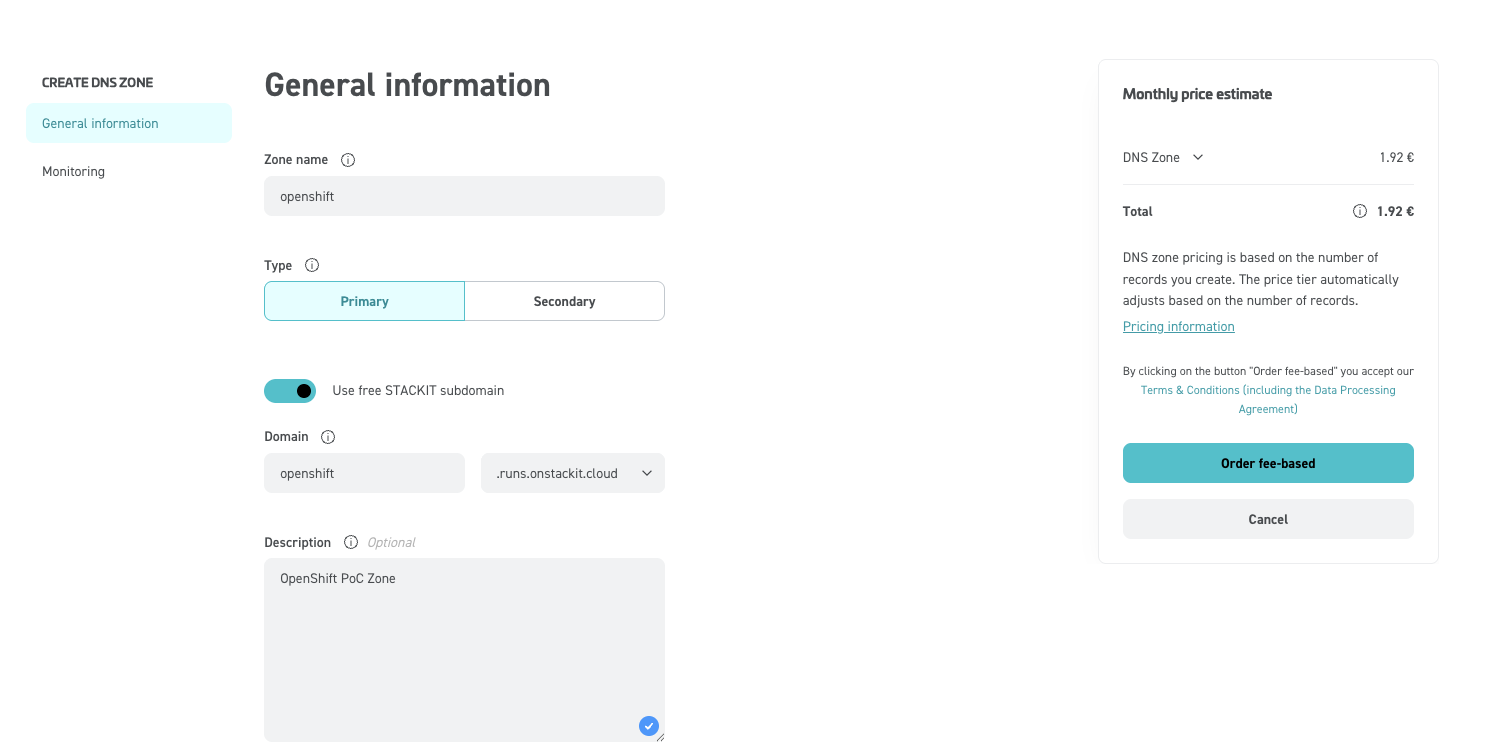
Primary zone for the install base domain (portal example: DNS zone). CLI list:

1
2
3
4
5
stackit dns zone list

 ID                                    NAME       STATE             TYPE     DNS NAME                        RECORD COUNT
──────────────────────────────────────┼───────────┼──────────────────┼─────────┼────────────────────────────────┼──────────────
 <ZONE ID>                             openshift  CREATE_SUCCEEDED  primary  openshift.runs.onstackit.cloud  0

Private network

stackit network create --name openshift --ipv4-prefix "10.0.0.0/24"
# note Network ID for server and LB args

Optional: helper / jump VM

For metadata checks, pulling artifacts, or debugging from inside the VPC. Butane source:

curl -L -O https://examples.openshift.pub/cluster-installation/stackit/ign-helper.rcc
variant: fcos
version: 1.5.0
ignition:
  config:
    merge:
      - source: "https://ignition.object.storage.eu01.onstackit.cloud/bootstrap.ign"

storage:
  files:
    - path: /etc/hostname
      overwrite: true
      contents:
        source: data:,helper
      mode: 0420
    - path: /home/core/.ssh/id_ed25519
      overwrite: true
      contents:
        local: .ssh/ocp-on-stackit
      mode: 0600
    - path: /home/core/.ssh/id_ed25519.pub
      overwrite: true
      contents:
        local: .ssh/ocp-on-stackit.pub
      mode: 0600
passwd:
  users:
    - name: core
      password_hash: "$y$j9T$15cuONdoH5AKB62c9qTtD.$oOf4GqrwEnNzT7WuEFvkDuSOyv2xIx/z4EXzbQivdO0"
      ssh_authorized_keys_local: 
        - .ssh/ocp-on-stackit.pub
stackit server create \
  --machine-type g1a.1d \
  --name helper \
  --boot-volume-source-type image \
  --boot-volume-source-id <RHCOS_IMAGE_ID> \
  --boot-volume-delete-on-termination \
  --boot-volume-size 120 \
  --network-id <NETWORK_ID> \
  --user-data @<(butane -d ~ -r ign-helper.rcc)
# Note server id

% stackit public-ip create
# Note public ip and ID

% stackit server public-ip attach \
  <PUBLIC-IP ID> \
  --server-id <SERVER ID>
% stackit security-group create --name allow-ssh
# Note security-group id

% stackit security-group rule create \
  --security-group-id <SECURITY-GROUP ID> \
  --direction ingress \
  --protocol-name tcp \
  --port-range-min 22 \
  --port-range-max 22

% stackit server security-group attach \
  --server-id <SERVER ID> \
  --security-group-id <SECURITY-GROUP ID>

% ssh -l core -i ~/.ssh/ocp-on-stackit <PUBLIC IP>
...
[core@helper ~]$ curl -s -q http://169.254.169.254/openstack/2012-08-10/meta_data.json | jq
{
  "uuid": "6f3fcf4f-c813-4cd6-b55d-b6fe309996f3",
  "hostname": "helper",
  "name": "helper",
  "launch_index": 0,
  "availability_zone": "eu01-m"
}

Object store

Object storage (bootstrap Ignition)

stackit object-storage enable
stackit object-storage bucket create ignition

stackit object-storage credentials create has been observed to panic in some CLI versions — create S3-compatible keys in the portal if needed.

Bootstrap object visibility

A wide-open bucket policy makes bootstrap.ign (cluster secrets) world-readable. Tighten to source IPs or VPC egress only; remove or restrict policy after bootstrap.

curl -L -O https://examples.openshift.pub/cluster-installation/stackit/s3-policy-all-public.json
{
    "Statement":[
        {
            "Sid": "allow-all",
            "Effect":"Allow",
            "Principal":"*",
            "Action":"s3:GetObject",
            "Resource":"urn:sgws:s3:::ignition/*"
        }
    ]
}
s3cmd --configure   # endpoint + keys from STACKIT object storage
s3cmd setpolicy s3-policy-all-public.json s3://ignition

Clear policy when done: s3cmd delpolicy s3://ignition

Ignition and install config

curl -L -O https://examples.openshift.pub/cluster-installation/stackit/install-config.yaml
apiVersion: v1
baseDomain: openshift.runs.onstackit.cloud
compute:
  - name: worker
    architecture: amd64
    hyperthreading: Enabled
    platform: {}
    replicas: 3
controlPlane:
  architecture: amd64
  hyperthreading: Enabled
  name: master
  platform: {}
  replicas: 3
metadata:
  name: cluster-a
networking:
  clusterNetwork:
    - cidr: 10.128.0.0/14
      hostPrefix: 23
  machineNetwork:
    - cidr: 10.0.0.0/24
  serviceNetwork:
    - 172.30.0.0/16
  type: OVNKubernetes
platform:
  none: {}

pullSecret: |
  REPLACE WITH YOUR PULL SECRET
sshKey: |
  REPLACE SSH KEY HERE from ~/.ssh/ocp-on-stackit.pub
Adjust install-config.yaml

Edit pullSecret, sshKey, and optionally metadata.name / baseDomain / machine replicas, then:

1
2
3
mkdir -p conf
cp install-config.yaml conf/
./openshift-install create ignition-configs --dir conf

Preserves conf/install-config.yaml (do not commit); emits bootstrap.ign, master/worker stubs, and auth/.

Upload bootstrap payload (the merge source in ign-bootstrap.rcc must match this object’s reachable HTTPS URL):

s3cmd put conf/bootstrap.ign s3://ignition/

Per-node Butane in this repo: bootstrap merges the object-store URL of bootstrap.ign; control plane nodes merge conf/master.ign, workers merge conf/worker.ign (paths relative to butane -d .).

Download node configs (or maintain alongside repo):

1
2
3
for node in bootstrap control-plane-0 control-plane-1 control-plane-2 worker-0 worker-1 worker-2; do
  curl -L -O https://examples.openshift.pub/cluster-installation/stackit/ign-${node}.rcc
done
variant: fcos
version: 1.5.0
ignition:
  config:
    merge:
      - source: "https://ignition.object.storage.eu01.onstackit.cloud/bootstrap.ign"
storage:
  files:
    - path: /etc/hostname
      overwrite: true
      contents:
        source: data:,bootstrap
      mode: 420
variant: fcos
version: 1.5.0
ignition:
  config:
    merge:
      - local: "conf/master.ign"
storage:
  files:
    - path: /etc/hostname
      overwrite: true
      contents:
        source: data:,control-plane-0
      mode: 420
variant: fcos
version: 1.5.0
ignition:
  config:
    merge:
      - local: "conf/master.ign"
storage:
  files:
    - path: /etc/hostname
      overwrite: true
      contents:
        source: data:,control-plane-1
      mode: 420
variant: fcos
version: 1.5.0
ignition:
  config:
    merge:
      - local: "conf/master.ign"
storage:
  files:
    - path: /etc/hostname
      overwrite: true
      contents:
        source: data:,control-plane-2
      mode: 420
variant: fcos
version: 1.5.0
ignition:
  config:
    merge:
      - local: "conf/worker.ign"
storage:
  files:
    - path: /etc/hostname
      overwrite: true
      contents:
        source: data:,worker-0
      mode: 420
variant: fcos
version: 1.5.0
ignition:
  config:
    merge:
      - local: "conf/worker.ign"
storage:
  files:
    - path: /etc/hostname
      overwrite: true
      contents:
        source: data:,worker-1
      mode: 420
variant: fcos
version: 1.5.0
ignition:
  config:
    merge:
      - local: "conf/worker.ign"
storage:
  files:
    - path: /etc/hostname
      overwrite: true
      contents:
        source: data:,worker-2
      mode: 420

Create servers

Use your RHCOS image ID and network ID; c2a.8d (or larger) is an example flavor.

for node in bootstrap control-plane-0 control-plane-1 control-plane-2 worker-0 worker-1 worker-2; do
  stackit server create \
    --assume-yes --async \
    --machine-type c2a.8d \
    --name "cluster-a-${node}" \
    --boot-volume-source-type image \
    --boot-volume-source-id <RHCOS_IMAGE_ID> \
    --boot-volume-delete-on-termination \
    --boot-volume-size 120 \
    --network-id <NETWORK_ID> \
    --user-data @<(butane -d . -r "ign-${node}.rcc")
done

stackit server list until nodes have addresses; map them into LB target pools and DNS as below.

Load balancers and DNS

Internal LB — api-int (6443, 22623)

curl -L -O https://examples.openshift.pub/cluster-installation/stackit/stackit-lb-int.json
{
    "listeners": [
      {
        "displayName": "api",
        "port": 6443,
        "protocol": "PROTOCOL_TCP",
        "targetPool": "api"
      },{
        "displayName": "machine-config-server",
        "port": 22623,
        "protocol": "PROTOCOL_TCP",
        "targetPool": "machine-config-server"
      }
    ],
    "name": "lb-int",
    "networks": [
      {
        "networkId": "<REPLACE WITH NETWORK_ID>",
        "role": "ROLE_LISTENERS_AND_TARGETS"
      }
    ],
    "options": {
      "accessControl": {
        "allowedSourceRanges": [
          "10.0.0.0/24"
        ]
      },
      "ephemeralAddress": false,
      "privateNetworkOnly": true
    },
    "planId": "p10",
    "targetPools": [
      {
        "name": "api",
        "targetPort": 6443,
        "targets": [
          { "displayName": "bootstrap","ip": "REPLACE WITH IP OF BOOTSTRAP NODE"},
          { "displayName": "control-plane-0","ip": "REPLACE WITH IP OF CONTROL PLANE 0 NODE"},
          { "displayName": "control-plane-1","ip": "REPLACE WITH IP OF CONTROL PLANE 1 NODE"},
          { "displayName": "control-plane-2","ip": "REPLACE WITH IP OF CONTROL PLANE 2 NODE"}
        ]
      },
      {
        "name": "machine-config-server",
        "targetPort": 22623,
        "targets": [
          { "displayName": "bootstrap","ip": "REPLACE with IP"},
          { "displayName": "control-plane-0","ip": "REPLACE WITH IP OF CONTROL PLANE 0 NODE"},
          { "displayName": "control-plane-1","ip": "REPLACE WITH IP OF CONTROL PLANE 1 NODE"},
          { "displayName": "control-plane-2","ip": "REPLACE WITH IP OF CONTROL PLANE 2 NODE"}
        ]
      }
    ]
}
Adjust stackit-lb-int.json

Fill target pools with control plane node IPs (API + MCS). Create LB:

stackit load-balancer create --payload @stackit-lb-int.json

Private VIP may not appear in stackit load-balancer list — take listener / pool IP from API or portal when wiring DNS.

api-int.<cluster_name> A record → internal LB VIP (example):

1
2
3
4
5
stackit dns record-set create \
  --zone-id <ZONE_ID> \
  --name api-int.cluster-a \
  --record 10.0.0.195 \
  --ttl 60

External LB — api and *.apps (6443, 80, 443)

Reserve a public IP for the external LB; point both api.<name>.<baseDomain> and *.apps.<name>.<baseDomain> at it (wildcard apps record).

1
2
3
4
stackit public-ip create
# attach to external LB / listener as required by STACKIT networking model
stackit dns record-set create --zone-id <ZONE_ID> --name api.cluster-a --record <PUBLIC_IP> --ttl 60
stackit dns record-set create --zone-id <ZONE_ID> --name '*.apps.cluster-a' --record <PUBLIC_IP> --ttl 60
curl -L -O https://examples.openshift.pub/cluster-installation/stackit/stackit-lb-ext.json
{
    "externalAddress": "<REPLACE WITH EXTERNAL IP ADDRESS>",
    "listeners": [
      {
        "displayName": "api",
        "port": 6443,
        "protocol": "PROTOCOL_TCP",
        "targetPool": "api"
      },{
        "displayName": "ingress-http",
        "port": 80,
        "protocol": "PROTOCOL_TCP",
        "targetPool": "ingress-http"
      },{
        "displayName": "ingress-https",
        "port": 443,
        "protocol": "PROTOCOL_TCP",
        "targetPool": "ingress-https"
      }
    ],
    "name": "lb-ext",
    "networks": [
      {
        "networkId": "<REPLACE WITH NETWORK_ID>",
        "role": "ROLE_LISTENERS_AND_TARGETS"
      }
    ],
    "options": {
      "ephemeralAddress": false,
      "privateNetworkOnly": false
    },
    "planId": "p10",
    "targetPools": [
      {
        "name": "api",
        "targetPort": 6443,
        "targets": [
          { "displayName": "bootstrap","ip": "REPLACE WITH IP OF BOOTSTRAP NODE"},
          { "displayName": "control-plane-0","ip": "REPLACE WITH IP OF CONTROL PLANE 0 NODE"},
          { "displayName": "control-plane-1","ip": "REPLACE WITH IP OF CONTROL PLANE 1 NODE"},
          { "displayName": "control-plane-2","ip": "REPLACE WITH IP OF CONTROL PLANE 2 NODE"}
        ]
      },
      {
        "name": "ingress-http",
        "targetPort": 80,
        "targets": [
          { "displayName": "worker-0","ip": "REPLACE WITH IP OF WORKER 0 NODE"},
          { "displayName": "worker-1","ip": "REPLACE WITH IP OF WORKER 1 NODE"},
          { "displayName": "worker-2","ip": "REPLACE WITH IP OF WORKER 2 NODE"}
        ]
      },
      {
        "name": "ingress-https",
        "targetPort": 443,
        "targets": [
          { "displayName": "worker-0","ip": "REPLACE WITH IP OF WORKER 0 NODE"},
          { "displayName": "worker-1","ip": "REPLACE WITH IP OF WORKER 1 NODE"},
          { "displayName": "worker-2","ip": "REPLACE WITH IP OF WORKER 2 NODE"}
        ]
      }
    ]
}
Adjust stackit-lb-ext.json

Adjust listeners and backends (API → masters; 80/443 → workers or ingress nodes), then:

stackit load-balancer create --payload @stackit-lb-ext.json

Bootstrap teardown and finish

./openshift-install wait-for bootstrap-complete --dir conf
s3cmd delete s3://ignition/bootstrap.ign
stackit server delete <bootstrap-server-id>

CSRs (if Pending — common when kubelet/API timing is tight):

export KUBECONFIG="$PWD/conf/auth/kubeconfig"
oc get csr | awk '/Pending/{print $1}' | xargs oc adm certificate approve

Re-run until nothing pending; machine-approver normally takes over post-bootstrap.

./openshift-install wait-for install-complete --dir conf

Console URL and kubeadmin password are printed on success.

Day-2: default Ingress TLS

Let’s Encrypt via cert-manager (DNS-01 / STACKIT)

Install cert-manager Operator for Red Hat OpenShift from OperatorHub (align minor with cluster; ships CRDs + controller).

Webhook identity — the STACKIT cert-manager webhook needs API credentials for DNS in the project that owns the public zone for *.apps (typically the same project as the cluster).

stackit service-account create --name cert-manager
# Export the service-account key JSON from the portal; keep it off shell history and out of docs.

Grant that principal DNS admin (or equivalent) on the zone:

Secret name below should match Helm values / webhook config for the STACKIT SA file:

1
2
3
oc create secret generic stackit-sa-authentication \
  -n cert-manager \
  --from-file=sa.json=./stackit-cert-manager-sa.json

Webhook (Helm):

1
2
3
4
5
6
7
helm repo add stackit-cert-manager-webhook https://stackitcloud.github.io/stackit-cert-manager-webhook
helm repo update
helm install stackit-cert-manager-webhook stackit-cert-manager-webhook/stackit-cert-manager-webhook \
  --namespace cert-manager \
  --create-namespace

oc -n cert-manager adm policy add-scc-to-user nonroot-v2 -z stackit-cert-manager-webhook

If the chart exposes secret name / key path values, point them at stackit-sa-authentication / sa.json.

ClusterIssuer (production ACME; use Let’s Encrypt staging while debugging):

apiVersion: cert-manager.io/v1
kind: ClusterIssuer
metadata:
  name: letsencrypt-prod
spec:
  acme:
    server: https://acme-v02.api.letsencrypt.org/directory
    email: Repalce # Replace this with your email address
    privateKeySecretRef:
      name: letsencrypt-prod
    solvers:
      - dns01:
          webhook:
            solverName: stackit
            groupName: acme.stackit.de
            config:
              projectId: "<STACKIT_PROJECT_ID>"

Wildcard Certificate in openshift-ingress for the default router:

apiVersion: cert-manager.io/v1
kind: Certificate
metadata:
  name: letsencrypt-wildcard
  namespace: openshift-ingress
spec:
  secretName: letsencrypt-wildcard
  issuerRef:
    group: cert-manager.io
    name: letsencrypt-prod
    kind: ClusterIssuer
  commonName: '*.apps.cluster-a.openshift.runs.onstackit.cloud' # project must be the owner of this zone
  duration: 8760h0m0s
  dnsNames:
    - '*.apps.cluster-a.openshift.runs.onstackit.cloud'

Match dnsNames / commonName to your apps subdomain. The projectId in the issuer must be allowed to publish _acme-challenge for that zone.

Observe issuance (DNS-01 can take several minutes):
oc -n openshift-ingress get certificate,order,challenge
oc -n openshift-ingress describe certificate letsencrypt-wildcard

Default IngressController → issued secret:

oc patch ingresscontroller/default -n openshift-ingress-operator --type=merge \
  --patch '{"spec":{"defaultCertificate":{"name":"letsencrypt-wildcard"}}}'

Until the secret is populated, the router keeps serving the installer default; after issuance, HAProxy reload picks up the Let’s Encrypt chain.


2026-05-05 2026-05-05 Contributors: Robert Bohne